Flyover KM 111 Construction Continues to Progress, Strengthening Coal Haul Road Connectivity
By: Admin01
Monday, 14 September 2026, 2:16 PM
 Flyover KM 111 Construction Continues to Progress, Strengthening Coal Haul Road Connectivity
Flyover KM 111 Construction Continues to Progress, Strengthening Coal Haul Road Connectivity
Flyover KM 111 Construction Continues to Progress, Strengthening Coal Haul Road Connectivity
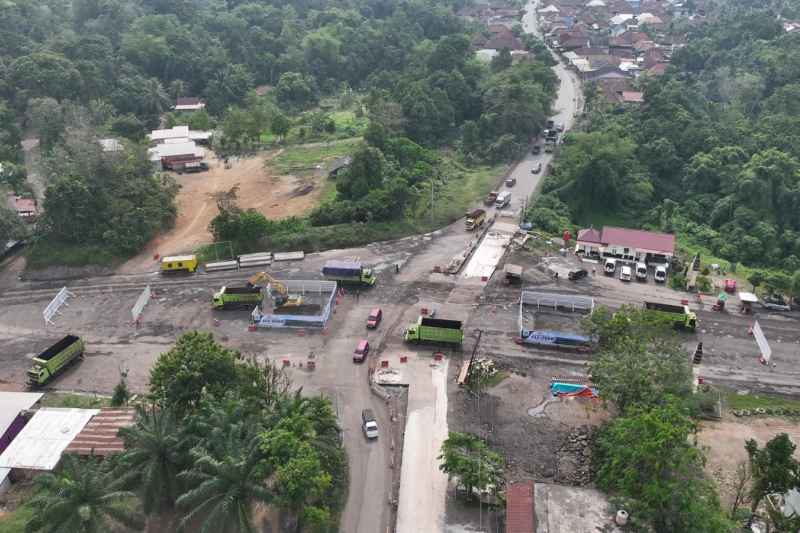
Lahat – Construction of Flyover KM 111 in Tanjung Jambu Village, Lahat Regency, South Sumatra, located along PT Servo Lintas Raya’s (SLR) dedicated coal haul road, continues to make progress. The infrastructure, which forms part of the Titan Group’s operational network, is designed to be approximately 400 meters long and 11 meters wide.
The construction of the flyover is part of the company’s efforts to strengthen connectivity across the dedicated coal haul road network, ensure smooth operations, and minimize potential disruptions to traffic during construction.
Flyover KM 111 was previously inaugurated by the Governor of South Sumatra in January 2026. Construction has now entered the foundation-building stage, along with several other preliminary works.
President Director of Titan Infra Sejahtera, Suryo Suwignjo, said construction was progressing according to plan. However, the company has not yet been able to confirm the exact percentage of completion, as work is still underway on several sections requiring technical adjustments.
"The progress is on track. The span is quite long, so there are several matters that need to be completed and adjusted. Therefore, thorough preparation is essential, and we cannot proceed too aggressively," said Suryo.
According to him, construction is estimated to require approximately 14 months from the current stage of work. Although the company hopes to complete the project sooner, safety, construction accuracy, and site conditions remain the top priorities.
One of the main considerations is the construction site’s proximity to a river. This condition requires careful assessment of technical aspects, including potential impacts on the surrounding environment and the structural strength of the foundations.
Suryo explained that during the initial stage, the company also carried out reinforcement and road-surface hardening at several public road crossing points. These measures were part of the construction process and were intended to ensure that construction activities did not disrupt traffic flow.
He emphasized that the increase in coal production is not directly related to the construction of the flyover. Operational activities are being increased gradually, while continuing to take into account the readiness of the entire road network.
"The key point is that the production process must not be disrupted. This flyover is one of the links in the overall road network and its interconnected system," he explained.
In addition to road infrastructure development, Titan Infra Sejahtera is also exploring opportunities to develop an electric vehicle ecosystem to support transportation operations along the dedicated coal haul road.
According to Suryo, electric vehicles offer several advantages, including energy efficiency, lower emissions, and relatively lower maintenance costs. Their management is also considered simpler compared with conventional fuel-powered vehicles.
However, implementing electric vehicles for coal transportation presents its own challenges. One of these is the length of the route. The dedicated road network, which extends approximately 120 kilometers, requires adequate electricity infrastructure.
"When we talk about electric vehicles, the infrastructure must be ready. We need to extend medium-voltage networks and carry out step-down transformations according to the requirements at operational points," said Suryo.
Therefore, the company is open to the development of a new investment ecosystem, particularly for parties interested in developing electric vehicles and their supporting infrastructure.
Titan Infra Sejahtera, Suryo continued, is open to such partnerships. With an ecosystem involving operators, investors, vehicle providers, and energy infrastructure providers, the use of electric vehicles along the dedicated coal haul road is expected to develop gradually.
"PLN is also very enthusiastic. This could become a symbiotic relationship. We want the ecosystem to take shape, but the infrastructure must also be prepared," he said.
The development is expected not only to support the company’s operational efficiency but also to create new investment opportunities throughout the coal transportation industry.
The construction of Flyover KM 111 and the exploration of electric vehicle adoption demonstrate that the development of the coal transportation industry is not solely about increasing production capacity. It also requires integrated infrastructure readiness.
The company hopes that government support and policies can continue to progress in line with ongoing investments. With tangible infrastructure development and continuous operational adjustments, various policies and dispensations are expected to be evaluated gradually in accordance with developments on the ground.
Ultimately, the construction of Flyover KM 111 is expected to become an important link in strengthening dedicated coal haul road connectivity, maintaining operational continuity, and supporting the development of a more efficient and sustainable transportation system in the future.

Graha Anabatic 8th floor
Jl. Scientia Boulevard Kav.U2
Summarecon Serpong, Tangerang
Banten 15811 Indonesia
 (021) 806 36888
corporate.secretary@titaninfra.com
Graha Titan, Perumahan Graha Bumi Enim,
Jl.Tjik Agus Kiemas, Muara Enim, Kab. Muara Enim
South Sumatera, 31311
Dusun Talang Betung,
Ds. Prambatan, Kec. Abab,
Kab. Penukal Abab Lematang Ilir, South Sumatera

